
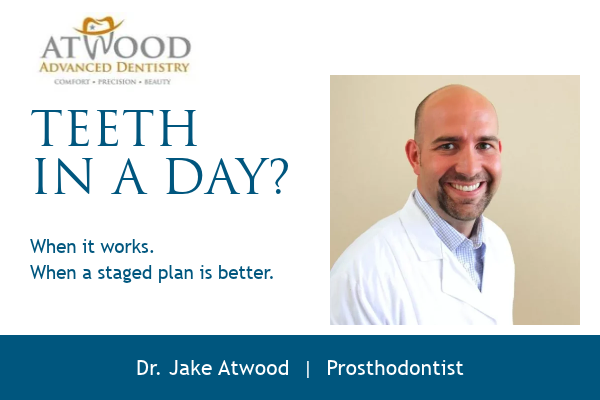
Teeth in a Day: When It’s Possible and When a Step-by-Step Plan Is Better
The idea of walking into a dental office with missing or failing teeth and leaving with a new smile is understandably appealing. “Teeth in a day” can be a valuable option for certain patients. Others benefit from treatment that allows more time for healing, rebuilding bone, or refining the fit of their replacement teeth.
At Atwood Advanced Dentistry in Grand Junction, Dr. Jake Atwood handles both appropriately selected same-day cases and complex treatment plans that unfold in stages. His advanced training in prosthodontics helps him determine which approach fits your needs and how to bring the entire restoration together.
The starting point for either approach is the same: a detailed plan.
What Does “Teeth in a Day” Actually Mean?
In implant dentistry, “teeth in a day” commonly describes placing dental implants and attaching replacement teeth during the same appointment. Extractions may also happen that day.
However, those first teeth are often temporary teeth designed for the healing period. The implants still need time to bond with the surrounding bone, and the final restoration is typically delivered later. Patients also need follow-up visits and must follow instructions about eating and protecting their new teeth.
There is another distinction: placing an implant immediately after removing a tooth does not automatically mean a tooth can be attached to that implant immediately. Implant placement and the timing of the restoration are separate decisions.
When Same-Day Teeth May Be an Option
Replacing a full arch of teeth
Patients who need all the teeth in an upper or lower arch replaced may qualify for a temporary fixed bridge attached to multiple implants on the day of surgery.
This requires sufficient support and strong initial implant stability. The number and placement of implants must also support the planned teeth and distribute biting forces appropriately. Carefully selected patients can achieve predictable results with this approach.
All-on-4® is one full-arch treatment approach, but the name alone does not establish whether someone qualifies for same-day teeth. The treatment timeline depends on the individual clinical findings.
Replacing a single tooth
In selected situations, a temporary crown can be attached when an implant is placed. Bone support, gum conditions, and implant stability influence this decision.
The temporary crown may need to be kept out of contact with the opposing teeth to protect the implant during healing. A same-day tooth does not mean it is ready for unrestricted chewing.
Receiving an immediate denture
An immediate denture is a removable denture prepared before extractions and inserted when the remaining teeth are removed. It can help patients avoid going without teeth during early healing.
This is different from a fixed implant bridge. As the gums and bone change after extractions, the denture may require adjustments, relining, or replacement to maintain an appropriate fit.
When a Staged Treatment Plan May Be Better
A longer treatment timeline can serve a specific purpose. Depending on your needs, it may allow tissues to heal, establish stronger support, or improve the design of the final teeth.
Bone needs to be rebuilt. Some patients require bone grafting or other preparation before implants can adequately support the restoration. The extent and location of that work can affect when implants and replacement teeth are placed.
Implants need to heal before supporting teeth. If sufficient stability cannot be achieved during placement, delaying the attachment of teeth may better protect healing. Even a planned same-day case needs an alternative approach if the conditions found during surgery do not support the original plan.
Infection or tissue conditions need attention. Acute infection, damaged bone around an extraction site, or unfavorable gum conditions may affect whether immediate placement and restoration are appropriate. These findings can make preliminary treatment and healing advisable.
The denture foundation is changing. After extractions, gums and bone reshape as they heal. Making the definitive denture after that initial healing period allows its fit to reflect the changed tissues. Temporary dentures can be considered during the transition.
A staged recommendation does not necessarily mean implants are off the table. It may mean additional steps are needed to make them a suitable option.
What Detailed Planning Adds to Your Treatment
Whether treatment moves quickly or takes several months, the replacement teeth need to work as part of your entire mouth.
A comprehensive implant or denture plan considers:
Which remaining teeth can be preserved.
Whether fixed teeth, removable implant dentures, or conventional dentures fit your needs.
Where implants should be positioned to support the planned restoration.
How the teeth will meet when you bite, known as "occlusion."
How the restoration will look and support your lips.
How you will clean and maintain it.
Dr. Atwood’s implant process includes 3D imaging and computer-based treatment planning. His prosthodontic training also includes comprehensive reconstruction and extensive laboratory work with dentures, partials, crowns, and bridges. That background connects the planning of the foundation with the design of the finished teeth.
Why Dr. Atwood’s Prosthodontic Training Matters
A prosthodontist is a dentist with advanced specialty training in restoring and replacing teeth.
After dental school, Dr. Atwood completed a three-year prosthodontic residency, with extensive training in dental implants, dentures, partial dentures, crowns, bridges, and comprehensive oral reconstruction. His training included fabricating dentures and partials himself, giving him firsthand experience with the details that affect their fit and appearance.
That expertise matters across the full range of treatment: from a single missing tooth to a full-arch implant restoration or a complex denture case.
At Atwood Advanced Dentistry, same-day treatment and staged treatment are both part of personalized restorative care. Dr. Atwood evaluates the complete case and recommends a sequence that supports the intended result.
Find the Right Plan for Your Smile in Grand Junction
If you are exploring dental implants or dentures in Grand Junction, your consultation should help you understand what is possible, what needs preparation, and what to expect at each stage.
Ask whether your first teeth will be temporary or final, what you can wear during healing, and how your treatment plan accounts for comfort, appearance, and maintenance.
Dr. Atwood’s advanced training in prosthodontics allows him to guide both straightforward and complex cases with attention to the complete restoration.
Schedule a consultation with Atwood Advanced Dentistry to explore a personalized implant or denture plan for your smile.

