
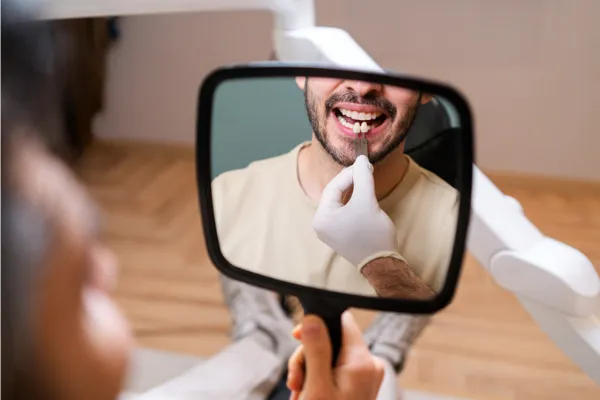
Dental Implants in Grand Junction: What to Know Before Choosing Treatment
Choosing dental implants starts with understanding your options—and who will plan your new smile.
Atwood Advanced Dentistry provides dental implants in Grand Junction with Dr. Jake Atwood, Grand Junction’s only prosthodontist. His approach emphasizes precision over speed, with attention to the function, comfort, and appearance of your replacement teeth.
Whether you need to replace one tooth, improve an unstable denture, or explore a full-arch restoration, a consultation should help you understand the complete treatment plan: what is recommended, why it fits your needs, what it costs, and what happens after treatment.
What are dental implants?
Dental implants are small devices surgically placed in the jawbone to support replacement teeth. Depending on your needs, they can support a crown, a bridge, or a denture.
The implant replaces the function of a tooth root. A connecting component, called an abutment, helps support the visible replacement tooth or teeth. Implants can improve chewing and appearance and help reduce jawbone shrinkage associated with tooth loss. The FDA’s guide to dental implants explains their components, benefits, and potential risks.
Why choose a prosthodontist for dental implants?
A prosthodontist is a dentist with advanced specialty training in restoring and replacing teeth. According to the American College of Prosthodontists, this includes three additional years of training in areas such as implants, crowns, bridges, dentures, bite relationships, and appearance.
That training matters because implant treatment involves both the foundation in your jaw and the teeth it supports.
Dr. Jake Atwood completed a three-year prosthodontic residency at Wilford Hall at Lackland Air Force Base. His training included comprehensive oral reconstruction, dental implants, dentures, crowns, bridges, and dental laboratory work.
For patients comparing dental implant providers in Grand Junction, useful questions include:
What formal training does the provider have in restoring and replacing teeth?
Who will plan and perform each stage of treatment?
Who will design and fit the final replacement teeth?
How will follow-up care and maintenance be handled?
The American College of Prosthodontists encourages patients to ask about a provider’s implant training, credentials, treatment timeline, and complete costs.
What does “precision over speed” mean for your smile?
At Atwood Advanced Dentistry, precision over speed is a guiding principle for restorative care.
A useful way to understand that principle is to look beyond the day an implant is placed. Your treatment plan should also address the teeth you will use afterward.
Before choosing treatment, ask:
How will my replacement teeth meet the teeth in the opposite jaw?
How will their shape, size, and shade be selected?
Will I be able to clean around the restoration?
What will I wear while healing?
What needs to happen before my final teeth are ready?
These questions help turn a broad promise of a “new smile” into a treatment plan you can understand and compare.
Which dental implant option might fit your needs?
The right restoration depends on how many teeth are missing, the condition of your mouth, and your preferences.
Option | What it replaces | Key distinction |
|---|---|---|
Implant-supported crown | A single missing tooth | A custom crown attaches to an implant |
Implant-supported bridge | Several missing teeth | Implants support a connected restoration |
Snap-on denture | Multiple or all teeth in an arch | The denture attaches to implants and is removable |
Fixed full-arch restoration | An upper or lower arch of teeth | The replacement teeth stay in place during daily use |
Implants can support both fixed and removable replacement teeth. Dr. Atwood can explain the appropriate design for your situation. American College of Prosthodontists: Implant FAQs
Atwood Advanced Dentistry offers snap-on dentures, single tooth implants, and All-on-4 treatment, in addition to other restorative options. All-on-4 is an approach to supporting a full arch of fixed replacement teeth with four implants. Some treatment plans use additional implants.
A fixed restoration and a removable snap-on denture have different care requirements. Understanding that distinction is an important part of choosing treatment.
How much do dental implants cost in Grand Junction?
Dental implant costs depend on the treatment you need. Replacing one tooth is different from rebuilding an entire arch. Extractions, bone grafting, and the type of final restoration can also affect the total. Dr. Atwood’s dental implant information explains why an examination is necessary to develop an individual treatment estimate.
When comparing estimates, ask for a written breakdown covering:
The examination and necessary imaging
Extractions or preparatory treatment
Implant placement and connecting components
Temporary teeth, when applicable
The final crown, bridge, or denture
Follow-up visits and expected maintenance
An advertised price is most useful when you know exactly what it includes. Ask whether it covers the complete treatment or one part of the process.
For example, a quote for implant placement and a quote that includes the final crown describe different scopes of care. Compare the proposed treatment, materials, and follow-up responsibilities alongside the price.
How long does the dental implant process take?
Dental implant treatment often takes several months, although the sequence and timing vary.
A typical plan may include an examination, any necessary preparatory treatment, implant placement, healing, and the final restoration. Bone grafting can add time when additional bone support is needed.
During healing, the bone forms a stable connection with the implant—a process called osseointegration. Some patients can receive replacement teeth at the time implants are placed, while others need to wait. Temporary teeth may be used before the final restoration is ready.
If you are considering “teeth in a day,” ask whether the teeth provided that day are temporary or final, what eating restrictions apply, and what treatment remains afterward.
Same-day treatment can be appropriate for selected patients. A carefully planned timeline should reflect your clinical needs and healing progress.
Am I too old for dental implants?
Age alone does not determine whether you can receive dental implants. The American Dental Association explains that overall health is more important than age when evaluating candidacy.
Adults in their 50s, 60s, 70s, and beyond may be candidates. The evaluation considers factors such as medical conditions, oral health, bone support, and the ability to heal and maintain the restoration. Tobacco use and some chronic illnesses can complicate healing.
Bring an up-to-date medication list and information about your medical history to your consultation.
What else should you ask before treatment?
Can I get implants if I have bone loss?
Possibly. Some patients need bone grafting to create adequate support. An examination and appropriate imaging help determine whether grafting or another treatment approach should be considered. Are dental implants painful?
Anesthesia is used to control pain during implant placement. Some soreness and swelling can occur afterward. Ask your provider what recovery may involve and how discomfort will be managed for your procedure.
What are the risks?
Possible complications include infection, damage to nearby structures, nerve injury, implant failure, and problems with the bite or implant components. Your provider should explain the risks relevant to your health and treatment plan.
How do I care for implant-supported teeth?
Daily cleaning and professional maintenance remain essential. Ask for instructions specific to your restoration, especially if you have a fixed full-arch bridge. Its design should allow effective cleaning, and your follow-up schedule should reflect your individual needs.
Schedule a dental implant consultation in Grand Junction
A consultation is an opportunity to understand your choices before committing to treatment.
Atwood Advanced Dentistry serves Grand Junction and surrounding Mesa County communities with restorative care focused on precision, function, and appearance. Dr. Atwood’s prosthodontic training supports a thoughtful approach to replacing missing teeth.
Bring your questions—and any treatment estimates you would like to discuss.
Atwood Advanced Dentistry
2478 Patterson Road, Suite 22
Grand Junction, CO 81505
Call (970) 241-2430 or request a consultation online.
Your next step is a clear understanding of your options and a plan built around your smile.

