Full-arch implants in Grand Junction: your complete guide
If you're researching full arch implants in Grand Junction, you're likely further along in this process than you realize. Most patients who reach out have already been living with the problem for a while, teeth that were once salvageable are now failing, and traditional dentures have started to feel like a permanent compromise rather than a real solution. They've read about All-on-4 somewhere online, but the path from "I've heard of this" to "I have an appointment" feels unclear, especially when specialist care has historically meant a long drive to Denver or Salt Lake City.
That's no longer the case. Atwood Advanced Dentistry brings prosthodontist-led, full-arch implant care to Mesa County, offering the same treatment options available at major urban centers, right here in Grand Junction. Whether you're a candidate for All-on-4, a fixed implant bridge, or implant-supported dentures, specialist-level evaluation and treatment are available without leaving the region.
This guide walks through everything you need to evaluate your options with confidence: the different full-arch approaches, who qualifies, what the process looks like from start to finish, what it costs locally, and why the type of provider you choose genuinely affects your outcome.
Full-arch implant options and how they differ
"Full-arch implants" is an umbrella term that covers several distinct treatment approaches. The right option depends on your bone volume, your budget, and your day-to-day lifestyle priorities. There is no single answer that works for everyone, but understanding the main options makes the consultation process much easier to navigate.
All-on-4: four implants, a full arch of teeth
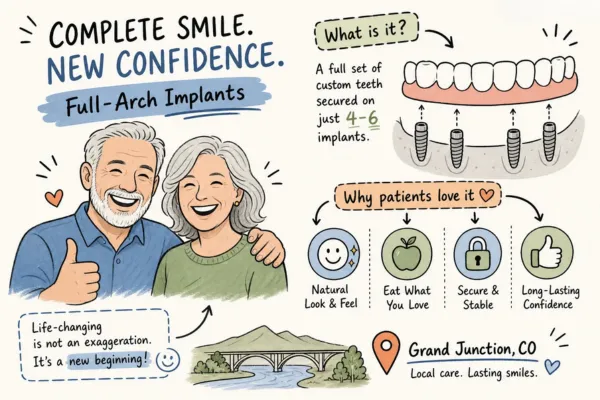
All-on-4 uses four strategically placed implants to support a fixed prosthesis that replaces every tooth in an entire arch. The design innovation is the angled placement of the two posterior implants, which maximizes contact with the bone that remains after tooth loss. This angled approach is why All-on-4 often eliminates the need for bone grafting, supported by published clinical studies, even in patients who have experienced significant bone resorption. It is one of the most widely used full-arch implant solutions nationally and is available to dental implants in Grand Junction without traveling out of region.
Implant-supported dentures vs. a fixed implant bridge
These two options feel very different in daily life. An implant-retained denture, sometimes called a snap-on denture, attaches to implants for stability but can be removed by the patient for cleaning. A fixed implant bridge is permanently attached and can only be removed by your provider. Many patients who qualify for a fixed prosthesis prefer it because it behaves more like natural teeth, no removal at night, no adhesive, and a more secure bite. Removable implant-supported dentures remain a strong option for patients who prefer easier at-home maintenance or have anatomical factors that favor that approach.
Same-day implants and immediate load protocols
Many full-arch cases allow patients to leave surgery with a temporary set of teeth the same day the implants are placed. This immediate load dental implants protocol is a genuine benefit, but it depends on specific conditions being met: adequate bone quality, sufficient implant stability at the time of placement, and no active infection at the surgical site. The temporary prosthesis placed on surgery day is not the final restoration. The permanent prosthesis comes after osseointegration, typically three to six months later, once the implants have fully fused with the jawbone. Same-day implants mean you leave functional; they don't mean the process is finished in a day.
Who is a good candidate for full arch implants in Grand Junction
Many adults with significant tooth loss are surprised to learn they may be candidates after a proper evaluation. All-on-4 in particular was engineered for patients with some degree of bone loss who would not qualify for traditional single-tooth implants placed across the full arch. The candidacy evaluation is a planning process, not a gatekeeping hurdle.
What your provider evaluates first
The initial assessment includes a thorough oral exam, 3D cone beam CT imaging to measure bone volume and density, and a review of your overall health and any active infections that need resolving before surgery. This imaging phase is where your provider determines which full-arch approach suits your anatomy and establishes a baseline that guides implant positioning and prosthesis design. Most patients move from this consultation to surgery scheduling within one to four weeks.
The bone graft question and graftless alternatives
Bone grafting comes up frequently in full-arch discussions, and for good reason: patients who have been without teeth for years often have measurable bone resorption. All-on-4 was specifically designed as a graftless alternative, using angled implant placement to access denser bone that remains even after significant loss. When grafting is needed, it extends the overall timeline, but it's a manageable step, not a disqualifier. Your 3D imaging will clarify which path applies to your anatomy before any treatment begins.
Health conditions that affect eligibility
Uncontrolled diabetes is the most significant medical factor in implant outcomes. Peer-reviewed implant studies consistently show that poorly controlled blood sugar impairs healing and increases failure risk, while well-managed diabetes generally allows for outcomes comparable to non-diabetic patients. Smoking impairs osseointegration and raises the risk of peri-implant complications. Most clinicians recommend cessation before and after surgery. Bisphosphonate medications, used for osteoporosis treatment, require careful evaluation because of their association with jaw healing complications, a risk area that dental and oral surgery guidelines, including those from the American Association of Oral and Maxillofacial Surgeons, specifically address in implant planning. None of these factors are automatic disqualifications, but they are important conversations to have during your consultation so your care plan accounts for them.
The treatment journey from first appointment to final teeth
Anxiety about full-mouth reconstruction almost always comes from not knowing what to expect next. The process is actually well-mapped and predictable once you understand each phase. Here is what the journey looks like for a typical patient seeking full arch implants in Grand Junction.
Consultation, imaging, and treatment planning
Your first appointment includes a clinical exam, a review of your dental and health history, and a 3D cone beam CT scan. From that imaging, your provider builds a personalized treatment plan that specifies which implant approach suits your anatomy, whether any preparatory procedures are needed, and what your final prosthesis will look like. Most patients move from this consultation phase to surgery scheduling within one to four weeks.
Surgery day and your temporary prosthesis
The surgical procedure for a full arch typically runs two to four hours, with anesthesia options to keep you comfortable throughout. For patients who qualify for immediate loading, a temporary fixed prosthesis is attached the same day, so you leave the office with functional teeth. The first 72 hours after surgery are the most important for rest, swelling and some discomfort are normal during this window. Most patients see significant improvement within the first two weeks.
Healing, final placement, and what osseointegration actually means
Osseointegration is the process by which your jawbone grows around and fuses with the implant surface, creating a stable biological anchor. This takes three to six months to complete and cannot be rushed. During this period you will follow dietary guidelines and attend follow-up appointments so your provider can monitor healing progress. Once osseointegration is confirmed, your final permanent prosthesis is placed. From that point, you eat, speak, and maintain your teeth the way you would natural ones, with routine professional checkups built into your long-term care plan.
What full-arch implants cost in Grand Junction
Cost is a real factor in this decision. Here is a realistic picture of what Grand Junction patients can expect to invest in 2026.
What drives the price up or down
The variables that most affect your specific cost include the number of implants required, whether bone grafting is part of your treatment plan, the prosthesis material selected, and the level of specialty training your provider brings to the case. Pricing at a specialist-led practice reflects more precise pre-surgical planning and a lower likelihood of complications that require additional procedures later. The upfront number is one part of the equation, the downstream cost of a well-executed plan versus a complicated one matters just as much.
Financing options and making it work locally
You do not need to pay the full treatment cost upfront. Atwood Advanced Dentistry offers Financing Options at Atwood Advanced Dentistry | Grand Junction, and those conversations happen during your consultation so you can walk away with a clear picture of both the clinical plan and the payment structure before you commit to anything. Ask the team directly about current financing terms and what's available for your situation. If cost has been a reason for delay, this is worth discussing early.
Long-term success rates and outcomes you can expect
Patients commonly receive conflicting information about how long full-arch restorations actually last. The published clinical literature offers a clearer picture.
Implant survival and patient satisfaction over 10+ years
According to peer-reviewed clinical literature, implant survival rates for full-arch restorations consistently fall in the 94 to 97 percent range at ten years, with some All-on-4-specific studies reporting prosthesis survival above 99 percent at the same interval. In most long-term follow-up studies reviewed, patient satisfaction exceeds 90 percent, driven by substantial improvements in chewing function, speech, and aesthetics. The distinction between implant "survival" and implant "success" matters: survival means the implant is still in place; success means it also meets clinical criteria for bone stability and function. Some implants that survive long-term require adjustments to meet full success criteria, which is why ongoing professional monitoring is a standard part of care.
What maintenance and complications actually look like
Prosthetic maintenance over a decade, screw tightening or veneer replacement, for example, is common and should not be interpreted as failure. These are routine aspects of owning a complex prosthesis, similar to maintaining any precision dental work. The primary biological risk to watch for is peri-implantitis, an inflammatory condition affecting the tissue around implants that can lead to bone loss if left unaddressed. Good home care, avoidance of smoking, and consistent professional checkups are the most effective tools for preventing it. Your provider builds this monitoring into your long-term care plan from day one.
Why specialist-led care changes outcomes for full-arch cases
Full-arch implant reconstruction is among the most technically complex procedures in dentistry. The type of provider you choose has a direct impact on your planning, your surgical outcome, and your long-term results. Specialty training exists precisely to address that complexity.
What a prosthodontist is trained to do differently
Prosthodontics is one of only nine dental specialties recognized by the American Dental Association. After dental school, prosthodontists complete an additional three years of residency training focused entirely on tooth replacement and restoration, including the design, placement, and long-term management of complex prostheses. General dentists can and do place implants, but implants represent one service among many in a broad general practice. For a prosthodontist, full-arch reconstruction is the core of clinical training and daily practice.
Full-arch care at Grand Junction's prosthodontist-led practice
Atwood Advanced Dentistry is a prosthodontist-led practice bringing that level of specialized training to patients in Mesa County. Before specialist care became available locally, Grand Junction residents facing complex tooth replacement often had to travel to Denver or Salt Lake City to access comparable credentials. That drive is no longer necessary. Comprehensive full-arch evaluation, treatment, and long-term follow-up are available here, close to home.
Taking the first step toward a consultation
The consultation is a conversation, not a commitment. You will leave with a clear understanding of which full-arch options suit your situation, what the treatment timeline looks like, and what it will cost, including available financing options if that's helpful. Dental Implants, Dentures, All-on-4 and More in Grand Junction to schedule your evaluation and start the process with the information you need to make a confident decision.
The bottom line on full arch implants in Grand Junction
Significant tooth loss is a real and common problem, and the options available to address it are better than ever. Whether All-on-4, a fixed implant bridge, or implant-supported dentures is the right fit depends on your bone volume, your goals, and your budget. The typical cost range for full arch implants in Grand Junction runs $20,000 to $35,000 per arch, the treatment timeline runs three to six months from surgery to final teeth, and the peer-reviewed long-term success data supports this as a durable investment. The key variable is getting evaluated by a provider with the right training to plan and execute a complex full-arch case correctly the first time.
Grand Junction residents no longer have to drive hours for specialist-level full-arch implant care, it's available right here at Atwood Advanced Dentistry. Reach out to schedule your consultation and find out which option fits your specific situation.

